Voodoo Casino licence and trust in Australia
 Available in AU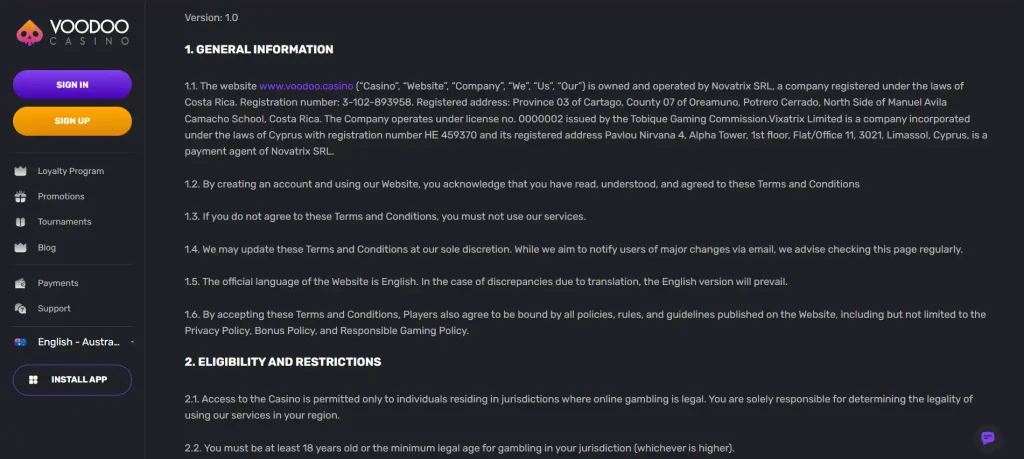
Licence and trust
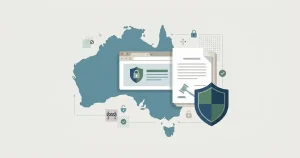
Voodoo Casino’s current Terms identify Novatrix SRL as the operator and state that the company operates under Tobique Gaming Commission e-gaming licence No. 0000002. That is a foreign licence claim, not an Australian licence. In a fresh check on 23 September 2026, no Voodoo or Novatrix entry was verified in the ACMA register of Australian licensed interactive gambling providers. For an Australian reader, those two facts need to remain separate: the Tobique licence tells you which overseas licensing framework Voodoo says it operates under, while the ACMA check addresses whether an Australian local licence was verified. It was not. The separate Australian-law page explains the provider-side legal restrictions in more detail.
Table of Contents
- Who operates Voodoo Casino
- The Tobique licence claim is specific and current
- What the ACMA register check tells an Australian reader
- Why foreign licensing does not create Australian protection
- Responsible-gambling tools are useful, but they are not licence proof
- Support and complaints are secondary trust signals
- ACMA enforcement involving Novatrix deserves careful context
- A practical trust checklist for Voodoo in Australia
- What Voodoo's licence does – and does not – verify in Australia
Who operates Voodoo Casino
The current Voodoo Terms and Conditions name Novatrix SRL as the owner and operator of the website. They describe Novatrix as a company registered under the laws of Costa Rica and provide company registration and address details. The same section states that Vixatrix Limited, a Cyprus company, acts as payment agent for Novatrix SRL. That payment-agent role is relevant because a payment descriptor or transaction relationship can involve a company that is not itself the casino operator.
For trust analysis, separating those entities is useful. The Voodoo Casino Australia review provides the broader site overview, while this page isolates licensing and trust evidence. Novatrix SRL is the operator identified by the casino’s terms. Vixatrix Limited is described as the payment agent. Neither label should be converted into a claim that an Australian regulator supervises Voodoo. Corporate identity, payment processing and gambling licensing are three related but different questions.
| Item | What is currently stated or verified | What it does not establish |
|---|---|---|
| Operator | Novatrix SRL | Australian licensing or local consumer protection |
| Payment agent | Vixatrix Limited is named as payment agent | That Vixatrix is the gambling operator |
| Foreign licence | Tobique Gaming Commission e-gaming licence No. 0000002 is stated in Voodoo’s terms | An Australian state, territory or federal gambling licence |
| Australian register check | No Voodoo or Novatrix local licence entry was verified in the ACMA register on 23 September 2026 | That the Tobique licence itself is invalid |
The Tobique licence claim is specific and current
Voodoo’s Terms were updated in August 2026 and state that Novatrix SRL operates under licence No. 0000002 issued by the Tobique Gaming Commission. Because the licence number is a high-risk fact, it is important not to rely on an old affiliate review or a copied footer. The current operator terms are the relevant primary source for what Voodoo itself represents.
That wording gives readers a concrete jurisdiction and licence number to record. It does not, by itself, answer every trust question. A foreign licence can establish that the operator claims to fall under a particular overseas framework, but it does not automatically import Australian complaint channels, Australian statutory safeguards or supervision by an Australian gambling regulator.
This is also why the phrase “licensed casino” needs context. It can be true in relation to a foreign licence while still being misleading if a reader reasonably interprets it to mean “licensed in Australia”. On this site, the jurisdiction is always stated with the licence claim so the two are not blurred together.
What the ACMA register check tells an Australian reader
ACMA maintains a register of licensed interactive gambling providers and tells Australians to check that register when assessing whether an online wagering service is licensed to operate in Australia. In the 23 September 2026 check used for this page, no Voodoo Casino or Novatrix SRL entry was verified in that register. The public claim is therefore limited to that result: no Australian local licence was verified for Voodoo or Novatrix in the current check.
That wording is intentionally precise. It does not say the Tobique licence is fake, and it does not claim that ACMA licenses every form of gambling in the same way. It simply answers the page’s local-licence question: the research did not produce an Australian register hit for Voodoo or Novatrix. Readers who want the broader legal framework, including the distinction between prohibited interactive casino services and licensed wagering services, should use the Australian online casino law and Voodoo Casino guide.
Why foreign licensing does not create Australian protection
Licence jurisdiction affects who sets operator rules, who may receive regulatory complaints and which consumer safeguards apply. If the licence is issued outside Australia, a player should not assume that Australian licensing mechanisms, local dispute processes or locally mandated protections attach to the account simply because the site can be opened from Australia or displays an Australian-facing locale.
This distinction becomes especially important around money disputes. A user may see familiar Australian currency options, an English-Australia site version or payment methods used locally. Those are commercial and localization features. They are not substitutes for a regulator-register entry. The same applies to account verification. Completing KYC can show that the operator has verified a player’s identity, but it does not transform the operator into an Australian licensee. The Voodoo Casino KYC guide covers the verification process without treating it as evidence of local regulatory status.
For the same reason, payout terms should be judged on their own published conditions. Withdrawal limits, verification dependencies and processing targets are operational rules set by the operator. They can help a player understand what to expect, but they do not prove Australian licensing. The separate Voodoo Casino withdrawal guide deals with those mechanics directly.
Responsible-gambling tools are useful, but they are not licence proof
Voodoo provides responsible-gambling controls including personal limits and self-exclusion options. Those are meaningful product features because they give a user tools to restrict or stop play. They should still be evaluated for what they are: account-level safeguards supplied by the operator. Their presence does not establish that Voodoo participates in Australian local regulatory systems.
This matters because different self-exclusion schemes can sound similar while having different scope. An operator-level self-exclusion applies within that operator’s own environment. Australian national systems for licensed wagering providers operate under a different legal framework. A Voodoo account tool should therefore not be described as equivalent to Australian regulatory coverage unless that equivalence is specifically verified.
From a practical trust perspective, the existence of limit and self-exclusion controls is still relevant. A reader evaluating the site can check whether those tools are easy to find, whether limits can be set before play escalates and whether support can explain how a closure or exclusion request works. Those observations add operational context without being used as a proxy for licensing.
Support and complaints are secondary trust signals
A current independent source reports 24/7 live chat for Voodoo, while the official site exposes support and complaints sections. These are useful service signals, but their evidentiary weight is lower than a licence register or current operator terms. A support channel can help resolve account questions, document requests or payment issues, yet it cannot answer the regulatory question by itself.
The best way to use support as a trust check is to ask concrete questions whose answers can be compared with published rules. Examples include where the withdrawal limits are stated, what documents are required for a specific KYC request, or how self-exclusion is actioned. Clear, consistent answers are more informative than generic assurances that the casino is “safe” or “licensed”.
Complaint handling should be read the same way. An internal complaints process can be useful, but it is not the same thing as access to an Australian regulator or ombudsman. If a dispute depends on licence jurisdiction, the relevant escalation route must be identified from the actual licence framework rather than assumed from the user’s location.
ACMA enforcement involving Novatrix deserves careful context
ACMA’s April to June 2026 enforcement report names Novatrix S.R.L. in formal warnings connected with two other gambling sites, Lucky Start and Daily Spins. The report describes findings involving prohibited interactive gambling services, and in the Daily Spins matter also unlicensed regulated interactive gambling services. This is current institutional information about the same operator name, but it should not be stretched beyond what the report says.
The report does not, in the cited passage, say that Voodoo Casino itself was the subject of those particular warnings. It therefore would be inaccurate to present those actions as a direct enforcement finding against Voodoo. What they do show is that Novatrix has appeared in recent ACMA enforcement material concerning other brands. For an Australian reader evaluating operator-level trust, that is relevant context and a reason to keep brand marketing, foreign licensing and Australian regulatory status analytically separate.
ACMA also continues to warn consumers that offshore services can lack important Australian consumer protections and publishes website-blocking and enforcement updates. Those broader warnings are part of the legal environment, while the Voodoo-specific question remains governed by the evidence attached to Voodoo and Novatrix themselves.
A practical trust checklist for Voodoo in Australia
- Confirm the operator name in the current Voodoo Terms rather than relying on an old review.
- Record the foreign licence exactly as stated, including the issuing jurisdiction and licence number.
- Check the ACMA register separately instead of treating a foreign licence as an Australian one.
- Do not infer Australian consumer-protection coverage from AUD support, an AU locale or accessible registration.
- Use responsible-gambling controls as operational safeguards, not as proof of regulator status.
- Use support and complaints channels for service questions, then compare answers with the published terms.
- Keep withdrawal and KYC rules separate from the licensing question, even though all three affect trust.
This checklist avoids a simplistic “legit or not” label. Trust is better analysed as a set of verifiable facts: who operates the site, what licence is claimed, whether a local register entry exists, what controls are available and which jurisdiction would matter if a dispute arose.
What Voodoo’s licence does – and does not – verify in Australia
Voodoo’s current terms identify Novatrix SRL as operator and state that it works under Tobique Gaming Commission e-gaming licence No. 0000002. That is the verified licence claim this page can make. The separate Australian check produced no verified Voodoo or Novatrix entry in ACMA’s licensed-provider register on 23 September 2026, so this site does not describe Voodoo as Australian-licensed or as covered by Australian local gambling protections. Responsible-gambling tools, support access and published account rules can still be useful operational trust signals, but none of them changes the licensing jurisdiction. For an Australian reader, the most accurate conclusion is therefore structural rather than promotional: Voodoo presents a specific foreign licence and identifiable operator, while Australian local licensing remains unverified and must not be inferred from access, currency or localization.